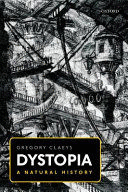
DYSTOPIA

DYSTOPIA

A NATURAL HISTORY : A STUDY OF MODERN DESPOTISM, ITS ANTECEDENTS, AND ITS LITERARY DIFFRACTIONS

GREGORY CLAEYS

38,74 €
IVA incluido
Ahora no hay ¿Lo buscamos? Escribenos
Editorial:
OXFORD
Año de edición:
2018
Materia
Ensayo literario
ISBN:
978-0-19-882047-5
Páginas:
556
Encuadernación:
Otros
38,74 €
IVA incluido
Ahora no hay ¿Lo buscamos? Escribenos

Dystopia: A Natural History is the first monograph devoted to the concept of dystopia. Taking the term to encompass both a literary tradition of satirical works, mostly on totalitarianism, as well as real despotisms and societies in a state of disastrous collapse, this volume redefines the central concepts and the chronology of the genre and offers a paradigm-shifting understanding of the subject. u003cpu003ePart One assesses the theory and prehistory of 'dystopia'. By contrast to utopia, conceived as promoting an ideal of friendship defined as enhanced sociability', dystopia is defined by estrangement, fear, and the proliferation of 'enemy' categories. A natural history of dystopia thus concentrates upon the centrality of the passion or emotion of fear and hatred in modern despotisms. The work of Le Bon, Freud, and others is used to show how dystopian groups use such emotions. Utopia and dystopia are portrayed not as opposites, but as extremes on a spectrum of sociability, defined by a heightened form of group identity. The prehistory of the process whereby enemies are demonised is explored from early conceptions of monstrosity through Christian conceptions of the devil and witchcraft, and the persecution of heresy. u003cpu003ePart Two surveys the major dystopian moments in twentieth century despotisms, focussing in particular upon Nazi Germany, Stalinism, the Chinese Cultural Revolution, and Cambodia under Pol Pot. The concentration here is upon the political religion hypothesis as a key explanation for the chief excesses of communism in particular. u003cpu003ePart Three examines literary dystopias. It commences well before the usual starting-point in the secondary literature, in anti-Jacobin writings of the 1790s. Two chapters address the main twentieth-century texts usually studied as representative of the genre, Aldous Huxley's Brave New World and George Orwell's Nineteen Eighty-Four. The remainder of the section examines the evolution of the genre in the second half of the twentieth century down to the present.u003cbru003e
Artículos relacionados

  • EPISTOLARIO FAMILIAR. CARTAS 1942-1945
    FORTÚN, ELENA
    Encarnación Aragoneses (Elena Fortún) escribió cientos de cartas desde su exilio argentino (1939-1948). El destinatario es su hijo Luis, exiliado a su vez en Nueva York. Cartas que son el único recurso para mantener el lazo de unión de una familia separada de forma forzosa y con pocas esperanzas de volver a encontrarse. Desde Buenos Aires Encarna se preocupa y vela por su hijo,...
    Quedan pocos

    22,90 €

  • LA BIBLIOTECA DE LOS SIETE MARES
    PECHMANN, ALEXANDER
    La biblioteca de Alexander Pechmann alberga una joya especial: un volumen con las pa´ginas amarillentas, el lomo desgastado y la cubierta de lino rojo manchada, como si hubiera estado durante meses a la deriva en un bote salvavidas. Se trata de la novela favorita de su tatarabuelo, marinero, al que se remonta la fascinacio´n familiar por la literatura mari´tima que se ha transm...
    Quedan pocos

    24,00 €

  • QUÉ ES EL PERIODISMO
    DE LA FUENTE, INMACULADA
    Con la colección Qué es, Sílex ediciones apuesta de nuevo decididamente por la divulgación rigurosa y exigente, pensada para todos los públicos (lectores), acercándoles la más alta calidad literaria del género ensayístico con la intención de ocupar un lugar notorio y reconocible en el panorama cultural escrito en español. El periodismo es el borrador de la historia, la primera ...
    Quedan pocos

    11,00 €

  • EL PERIÓDICO DE LA DEMOCRACIA
    CERCAS, JAVIER
    El nuevo libro de Javier Cercas relata los últimos 50 años de la historia de España, que son los del diario El País, a través de un recorrido personal y una lúcida reflexión sobre los vínculos entre periodismo, literatura, política y libertades. El diario El País salió a la calle el 4 de mayo de 1976, menos de seis meses después de la muerte de Franco, cuando el camino a la dem...
    En stock

    14,90 €

  • EL LIBRO INFINITO
    LOZANO SAGRERA, ANTONIO
    Un homenaje imprescindible a La broma infinita en el 30º aniversario de su publicación. El 1 de febrero de 1996 irrumpió en EE. UU. La broma infinita, un mamut celebrado como obra genial e inclasificable, que generaría un culto fanático, un sinfín de estudios académicos y abundantes guiños en la cultura popular. Treinta años después, su osadía y carácter visionario siguen intac...
    En stock

    12,90 €

  • ENVIADO ESPECIAL
    PÉREZ-REVERTE, ARTURO
    UNA BIOGRAFÍA DE GUERRA Un libro imprescindible para comprender la mirada literaria de Arturo Pérez-Reverte «Caminé por un mundo en guerra intentando comprender. No me lo contaron. Estuve allí, y esto es lo que vi». Durante veintiún años como reportero de guerra, Arturo Pérez-Reverte vivió en primera línea los conflictos más cruentos del último tercio del siglo xx. Su experienc...
    Quedan pocos

    23,90 €